09/10/2026
Gaming as a tool for teaching, reflection, innovation and as a subject of research


Stéphane GORIA

Philippe LEPINARD
For a long time associated with leisure or teaching in the early stages of the French education system, play and games have now become a valuable tool for organizations. Whether in the form of a recreational activity or one with a professional purpose, companies, government agencies, and universities see these practices as a unique way to train, innovate, foster cooperation, and support organizational change.
This trend is widely observed in the academic world, where several French research associations now have working groups dedicated to studying the use of games to achieve learning objectives or devise innovative applications. As a result, a true interdisciplinary and interprofessional ecosystem has taken shape around these practices. In France, for example, associations such as the Guilde des Ludopédagogues francophones, the Consortium francophone de la ludopédagogie, l’Association Française d’Étude du Wargaming (AFEW), and the Syndicat des Serious Game Designers are now helping to foster networks and disseminate research, while professional events such as LudiNord Pro et Wargaming à Paris bring together researchers, educators, designers, and others interested in games used for practical purposes. Moreover, the partnership announced between the Colloque International Game Evolution (CIGE) and LudiNord Pro for 2027 clearly illustrates the desire to bridge the gap between academic research and the professional world.
The growing prominence of game-based practices in organizations stems in particular from their ability to provide diverse experiences and to serve as a transitional bridge between theory and either faithfully simulated or real-world professional practices. For example, unlike a lecture, many games place learners in situations where they must act, cooperate, make decisions, and observe the consequences of those decisions. This experiential dimension of play thus explains, at least in part, their success in training fields where they are commonly referred to as game-oriented learning. In these contexts, games help develop both technical skills and interpersonal qualities, such as communication, leadership, and conflict management. These applications are diverse and may rely on serious games designed specifically for this purpose. However, other approaches can also be employed, such as the occasional incorporation of game mechanics (challenges, levels, rewards, illustrations, etc.) into professional activities to boost motivation or engagement (known as gamification), or approaches that involve repurposing existing games and toys for educational aims (known as serious gaming and serious play), as explored by the EdUTeam research program.
Beyond training—and for more than 30 years now—certain methods have used play as a tool for collective thinking. This is the case, for example, with the LEGO® SERIOUS PLAY® method, which helps teams build a shared vision or innovate using LEGO® brand materials. We can also mention game jams (creative design game hackathons), where groups quickly design a game prototype to stimulate their creativity, learn to work in teams, and/or showcase their skills. For example, an event of this kind was recently organized during the Wargaming in Paris event. The challenge involved designing educational wargames aimed at helping the public learn how to combat disinformation. In fact, wargaming (or the practice of playing specific games known as wargames) has been experiencing a significant resurgence since the early 2020s. Indeed, these wargames (or simulation games depicting conflicts, which very often take the form of board games or miniature games but can also be offered in digital format) make it possible, in particular, to better understand and grasp complex situations. Thus, for the past two centuries, these games have been used to train military personnel or to aid their strategic thinking. However, today they are also used to explore different scenarios, test strategies, or analyze risks in fields as varied as cybersecurity, civil security, diplomacy, and public health. The creation of AFEW (see above) and the development of the traveling exhibition “War Games: Two Centuries of Simulation”, and the Wargaming event in Paris reflect this broadening of applications and the growing interest in these simulation games within organizations.
Gaming can also be a powerful tool for exploring potential solutions that enable more effective innovation. The famous computer program Foldit is a good example: by logging in, thousands of players attempted to solve scientific problems presented as digital puzzles (of increasing difficulty) that required finding the correct three-dimensional folding structure of a protein. And it worked! Three weeks after the program went live, a player found a solution to a problem that years of biomedical research and computer simulations had failed to solve, demonstrating that collective intelligence combined with gaming can produce rapid and meaningful results.
Photo : CR
However, introducing games into an organization is not without its challenges. Indeed, by its very nature, a game typically relies on the voluntary participation of players. Yet in the workplace, games are often incorporated into mandatory training sessions or corporate seminars that are difficult to avoid. This contradiction can reduce participant engagement and limit the expected benefits. Similarly, a program that is poorly designed or ill-suited to its audience risks being perceived as patronizing, artificial, or an additional burden rather than a motivating experience. Likewise, many criticisms of game-oriented learning practices are similar to those leveled at active learning methods, as they require individuals to present themselves extensively and under pressure in front of a group. Thus, gamification in organizations has certain limitations. When the added gamification system relies solely on rankings or rewards, it can encourage excessive competition among staff at the expense of their ability to cooperate, exacerbate internal tensions, prioritize certain performance indicators over others, or divert attention from the organization’s true objectives to focus solely on those reflected in the gamified system. Finally, certain ways of playing games can lead to a form of professionalization in which enjoyment gradually gives way to performance, as is sometimes seen in esports or video game streaming. The experience provided by gaming once again gives way to a work routine.
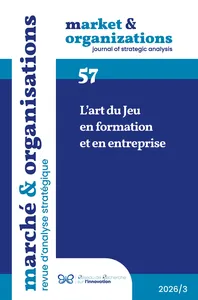
These various aspects of games repurposed for practical use are now the focus of extensive research, including studies in French-speaking countries. In particular, they are the central theme of several special issues of French scientific journals, including—for the year 2026 alone—Market & Organizations (on games in business and training), Les Cahiers pédagogiques (on games and learning), the Revue internationale d’intelligence économique (on the contributions of wargaming to civilian fields), and Sciences du jeu (on game-based modeling and mediation in the workplace). Taken together, these recent publications clearly demonstrate that games are no longer viewed merely as a form of entertainment, but as a genuine subject of research with multiple dimensions.
More than just a trend—whether from the perspective of research, education, or a wide range of professional fields—gaming thus emerges as a tool for reflection, creation, and action that serves organizations, which must be able to embrace it while understanding its scope and limitations in order to implement it under optimal conditions.
To learn more on this topic:
Goria, S., & Lépinard, P. (2026). Des jeux dans les organisations : quels mots pour en parler ? Marché & organisations, 57(3), 5-31.
Lépinard, P. (2023). L’apprentissage expérientiel par le jeu pour l’acquisition des connaissances théoriques managériales. Recherches en Sciences de Gestion, 158, 489-516.
Lépinard, P. (2025). Panorama et perspectives du wargaming dans les sciences sociales. Management & Sciences Sociales, 41(2), 158-175.
The Authors
Stéphane GORIA is a professor in information and communication sciences at the University of Lorraine and co-director of the Pixel research team at Crem (Center for Research on Mediations). He is also a member of the RRI and the AFEW. His research focuses, in particular, on the acquisition, design, and use of information for innovation, as well as on the use and repurposing of games or play for these purposes.
Philippe LEPINARD is an associate professor of business and management sciences at IAE Paris-Est, the business school of the University of Paris-Est Créteil (UPEC). He heads several degree programs in cybersecurity, coordinates the EdUTeam research program on game-oriented learning, and is co-director of the “Educational Innovations and University Dynamics” research area at the Institute for Management Research (IRG, 2354).
FOCUS :