18/07/2026
The Chinese Space Aircraft Carrier: Institutional Science Fiction

Thomas MICHAUD

Jean Paul PINTO MORALES
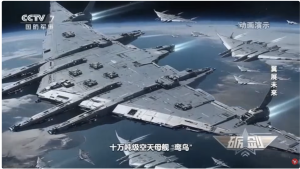
On January 9, 2026, CCTV, China’s state television network, broadcast a spectacular video showcasing a project for a gigantic space aircraft carrier. Luanniao was envisioned as measuring 242 meters in length, with a wingspan of 684 meters and a displacement of 100,000 tons, capable of carrying 88 Xuan Nu combat drones. This vessel would be designed to operate in the upper atmosphere, at the edge of space, and potentially strike any point on the planet with unparalleled speed and efficiency.
The sheer scale of the project immediately raised questions among major media outlets, particularly in the West. Had China achieved a technological breakthrough enabling the creation of a system worthy of science fiction blockbusters, or had it instead employed the tropes of fantasy narratives as a tool of military propaganda?
Source vidéo : CCTV-7 (China Central Television), YouTube.
An Example of Institutional Science Fiction
At present, there is no evidence that such a device is technically viable. China is more likely employing the tropes of institutional science fiction (Michaud, 2023) for military propaganda and soft power purposes. This mode of communication is not new, as the world’s most powerful militaries have long used similar approaches to showcase their most ambitious strategies and technologies.
For instance, between 2020 and 2023, the French Red Team brought together around ten science fiction specialists to imagine potential threats that could affect France by 2060. The authors envisioned scenarios such as conflicts between multinational corporations on the Moon leading to nuclear war, or engrammatic technologies capable of transforming any citizen into a formidable soldier through cognitive data transmission.
By identifying weak signals and envisioning disruptive historical developments, science fiction becomes a powerful tool for foresight. More than that, it lies at the very heart of military communication. During the Iran-Contra affair, the U.S. government reportedly used imagery inspired by blockbuster films for propaganda purposes. The objective is to tap into the collective imagination of the future, appealing to familiar cultural patterns in order to frame military strategy in a grand—if not megalomaniacal—manner.
Moreover, many fictional technologies initially appear improbable or even absurd, raising doubts about their seriousness. This is precisely what occurred with the Chinese government’s video. Observers were stunned by a project seemingly disproportionate to current military capabilities. Yet, through this short film, the Chinese military demonstrated its ability to operate within the realm of institutional science fiction, positioning itself as a serious competitor alongside other global powers—particularly the United States.
Over the past decade, the Chinese state has actively integrated science fiction into its ideological framework. It promotes this imaginative domain across institutions, training centers, universities, the military, and industry to engage younger generations in technoscience. Riding the wave of success of authors such as Liu Cixin and films like The Wandering Earth (2019), China is, in many ways, replicating the American model, which leverages science fiction to introduce scientific, political, and military narratives to the public.
While the United States has long been regarded as the birthplace of modern science fiction—with such narratives acting as drivers of innovation—China has clearly recognized their strategic potential and is now using them as tools of soft power. Historically, military forces have relied on grandiose narratives to announce superior technologies and weapons, aiming to inspire both fear and respect. During the Cold War, for example, the United States and the Soviet Union competed through increasingly ambitious and imaginative projects:
- Project Stargate explored remote viewing to visualize Soviet installations.
- Project Horizon aimed to establish a lunar base to secure strategic dominance.
- Project A119 proposed detonating a nuclear device on the Moon as a demonstration of power.
- The Philadelphia Experiment became a legendary account of alleged military invisibility testing.
These projects, varying in credibility, illustrate how speculative concepts can influence strategic thinking. In today’s tense geopolitical climate, it is therefore plausible that such Chinese initiatives may be taken seriously by military institutions.
China, Major Technological Projects, and Premonitory Fiction
In its ambition to become a global leader, China has undertaken grand-scale projects such as the Three Gorges Dam—the largest in the world (Sanjuan & Béreau, 2001)—as well as plans for a massive new dam in the Himalayas, estimated at $168 billion. Within this context, the presentation of highly complex and ambitious projects is not unusual, as China consistently seeks to assert its technological capabilities.
Following this logic, China unveiled the Luanniao space aircraft carrier in January 2026. A video released online highlights its potential capabilities and its ability to operate near the Earth’s atmosphere, fueling debates about the future of warfare and the possibility of conflicts over extraterrestrial resources. This vision aligns with the ambitions of entrepreneurs such as Musk and Bezos to extend economic activity into space (Michaud, 2022).
The aircraft carrier is part of the Nantianmen project, and within this framework, China’s long-term capacity to develop such technologies cannot be entirely dismissed. As Brandon Weichert suggests, China may seek to convince the world of its ability to manufacture flying aircraft carriers—even if such capabilities remain speculative.
At present, such defense technologies remain firmly within the realm of science fiction. However, numerous innovations—from Star Trek-inspired communication devices to tablet technologies envisioned by Arthur C. Clarke—demonstrate how fiction can anticipate and inspire real-world developments.
In this sense, science fiction has the capacity to prefigure the future, motivating scientists and engineers to develop prototypes that may eventually attract investment. Future projects should not be assessed solely based on present capabilities, but rather on the potential capabilities organizations may develop (Hamel & Prahalad, 2010).
China’s presentation can also be interpreted as a form of psychological warfare, aimed at influencing the perceptions and emotions of rival nations—particularly the United States. By leveraging science fiction, such narratives make abstract technological futures more tangible (Bell et al., 2013).
Science fiction enables a far more compelling and dramatic presentation of technological possibilities than conventional, data-driven foresight reports (Klein, 2016). In this regard, design fiction complements both strategic foresight and science fiction by transforming abstract questions into tangible scenarios through diegetic prototypes—artifacts that help audiences suspend disbelief in the face of possible futures (Kerspern, 2018).
More broadly, speculative design seeks to bring people closer to possible futures, enabling them not only to imagine but also to experience them. This process—what Pinto (2024) refers to as the materialization of the future—engages multiple senses, making future scenarios more vivid and convincing.
Ultimately, uncertainty becomes an opportunity: it allows for the creation of concepts and products that do not yet exist. At some point, these fictional designs may inspire real technological developments, fulfilling Arthur C. Clarke’s well-known proposition that sufficiently advanced technology is indistinguishable from magic. The Chinese space aircraft carrier fits squarely within this visionary tradition.
References
Bell, F., Fletcher, G., Greenhill, A., Griffiths, M., & McLean, R. (2013). Science fiction prototypes: Visionary technology narratives between futures. Futures, 50, 15–24. https://doi.org/10.1016/j.futures.2013.04.004
Hamel, G., & Prahalad, C. K. (2010). Strategic Intent. Harvard Business Review, (21 juin).
Kerspern, B. (2018). Economic Design Fictions: Finding the Human Scale. In Economic Science Fictions. Goldsmiths Pres.
Klein, G. (2016). L’invention de l’avenir : prospective et science-fiction. Futuribles.
Michaud, T. (2022). De la fiction a l’innovation. Ces visionnaires qui ont changé le monde. Editions Le Manuscrit, Paris.
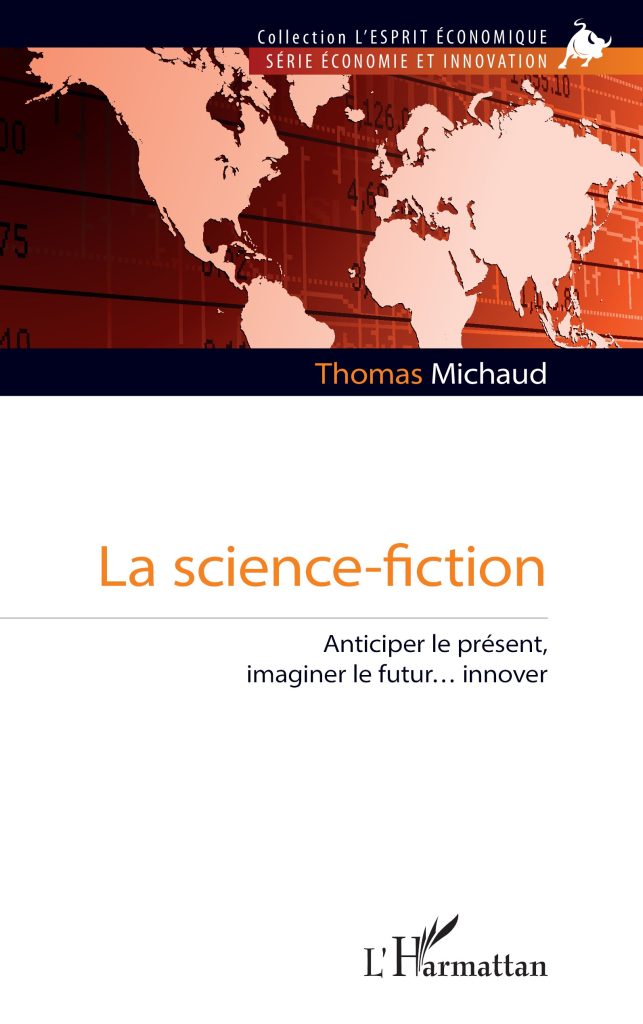
Michaud, T. (2023). La science-fiction institutionnelle. L’Harmattan, Paris, 2023.
Pinto, J. P. (2024). Sobre la materialización del futuro. Uteg Editorial.
Sanjuan, T. et Béreau, R. (2001). Le barrage des Trois Gorges Entre pouvoir d’État, gigantisme technique et incidences régionales. Hérodote, 102(3), 19-56. https://doi.org/10.3917/her.102.0019.
The Authors
Thomas MICHAUD is an associate researcher at the ISI/Lab.RII Research Unit at the Université du Littoral, Côte d’Opale, France and the director of Futurofictions, specializing in the creation of narratives and analyses of science fiction works for the purpose of future forecasting.
Jean Paul PINTO MORALES, professor and researcher at UTEG University, Guayaquil, Ecuador, specializing in strategic foresight and innovation processes; holds a doctorate in administrative sciences from Universidad del Valle, Cali, Colombia.
FOCUS :