25/10/2026
Rethinking Innovation? Considering Major Transformations Through Tensions

Amel ATTOUR


Cécile AYERBE

Valentine GEORGET

Lise ARENA

Nathalie ORIOL
General context
For several decades, the innovation literature has increasingly used adjectives to describe new ways of innovating: frugal innovation, responsible innovation, low-tech innovation… All these models seek to rethink innovation practices so as to combine socio-environmental challenges with economic imperatives.
What if, ultimately, rethinking innovating were not about finding a new label, but about accepting that we operate in a complex and multidimensional world; a world in which tensions, contradictions and paradoxes coexist, without necessarily having to resolve them, but rather bringing them to light in order to think through these dualities?
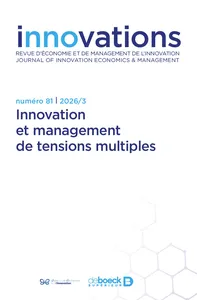
This is precisely what the special issue of Innovations, “Rethinking Innovation? Reading Major Transformations Through Tensions,” proposes. Rather than adding yet another qualifier, it chooses to embrace these tensions as constitutive dynamics of any innovation process, rather than as anomalies to be corrected. Rethinking innovation would therefore be less about choosing one side than about finding ways to enable, over time, the coexistence of logics that may initially seem difficult to reconcile. Such a perspective is rooted in the organizational paradox literature, according to which tensions never truly disappear: they are recomposed, displaced, and must be managed rather than definitively resolved. It also resonates with process perspectives on innovation, which focus on the dynamics of organizational transformation.
Four generative tensions
Drawing on the contributions of the authors in this special issue, the guest editors identify four tensions that currently run through innovation practices.
The first tension is between performance and impact. It concerns trade-offs between economic objectives and societal and environmental requirements. It lies at the heart of contemporary debates about the purpose of innovation: is innovation intended to increase performance, to address social and environmental challenges, or to try to hold these two imperatives together? This tension is explored in a particularly original way through a reflection on sustainable frugal innovation, showing how trade-offs between environmental quality, affordability and sustainability can themselves become sources of innovation. By mobilizing the emerging concept of the environmental quality/price trade-off, the authors propose an analytical framework for understanding how certain forms of innovation are positioned at the intersection of environmental requirements and economic constraints.
The second tension concerns openness and control. It refers to trade-offs between sharing and protecting the resources mobilized in innovation processes. It raises the question of how organizations can benefit from access to external knowledge, skills and resources while preserving their ability to coordinate and appropriate the value created. Fundamentally, it raises the issue of resource governance, particularly the governance of information resources. This is illustrated through the case of agricultural data governance, where data are considered as information goods. Such data become particularly sensitive when they can be valorized, shared or reused, creating risks of appropriation and value capture by actors that possess the technical, organizational and legal infrastructures required to exploit them. How can a sector benefit from data sharing without losing control over those data, or allowing the value created to be captured by the actors best equipped to exploit them? Such questions take on new significance in the study of data- and artificial intelligence-based business models. They illustrate how contemporary digital transformations are redefining the boundaries of innovation and organizations’ capacities to design, recombine and evolve their business models. Issues relating to ethics, sustainability, data sovereignty and platform dependence also show that these new models are accompanied by growing tensions in governance, appropriation and responsibility.

Photo : Ron Lach
The third tension is between exploration and exploitation: how can organizations maintain a balance between consolidating existing routines and opening up new possibilities? In other words, it concerns how organizations can reconcile experimentation and efficiency, adaptation and stability, novelty and continuity. From this perspective, rethinking innovating is less about choosing between exploration and exploitation than about organizing their coexistence over time. The case of collaborative robotics provides an original illustration of this duality. Far from being a technological magic bullet that would mechanically improve productivity and working conditions, the introduction of a cobot only acquires meaning through the way it is actually understood and used by the teams that work with it every day. Training, openness in work organization and the mobilization of collective expertise therefore shape its actual effects. In this sense, it illustrates particularly well the idea that “rethinking innovation” is less about deploying new technologies than about organizing the conditions for their appropriation and ongoing revision.
Finally, the fourth tension is between the individual and the collective. Actors must both assert their own identity and align themselves with group expectations. More specifically, this tension concerns the gaps between the initiatives, values and responsibilities carried by individual actors—innovators, intrapreneurs, managers and researchers—and the collective frameworks within which innovation is defined, oriented and evaluated: governance arrangements, decision-making arenas and organizational regulations. This tension is explored in the special issue through the adoption of a managerial innovation in an SME engaged in a liberated company project. The study shows that this adoption results neither from a single decision nor from a linear process, but from a collective construction of meaning involving internal and external actors whose expectations may sometimes diverge.
An invitation to change perspective
Taken together, these four tensions suggest that there are ways of working with tensions rather than claiming to have moved beyond them: by identifying them, understanding how actors negotiate them in their everyday activities, and accepting that they return in renewed forms as organizations evolve.
For anyone interested in ongoing transformations – practitioners, decision-makers, or simply those curious about the changes reshaping work and organizations – this perspective offers a useful analytical lens for enriching innovation models that seek to address major challenges. It encourages us to be wary of overly simple solutions and instead to observe the trade-offs through which innovation actually takes place. Rather than seeking to eliminate the tensions inherent in innovation, this special issue places them at the heart of the analysis, as drivers of the recomposition of practices and models.
For further discussion of these tensions and the empirical settings through which they are illustrated, the full special issue is available in Innovations.
The Authors
Amel ATTOUR is Full Professor of Management at Université Côte d’Azur and a member of GREDEG (UMR 7321), where she serves as Deputy Director. Her research focuses on business model innovation within ecosystems. She teaches strategic management to undergraduate students and innovation within ecosystems at the research-oriented Master 2 level.
Cécile AYERBE is Full Professor of Management at Université Côte d’Azur and a member of GREDEG (UMR 7321). She co-directs the Master’s program Research in Management and Innovation. Her research focuses on innovation management and intellectual property management.
Valentine GEORGET is Associate Professor of Management at Université Côte d’Azur and a member of GREDEG (UMR 7321). Her research focuses on innovation management, particularly responsible innovation and innovators’ occupational health.
Lise ARENA is Full Professor of Management at Université Côte d’Azur and a member of GREDEG (UMR 7321). Her research focuses on organizational innovation and digital transformation processes, which she studies from a historical and longitudinal perspective at the intersection of information systems, innovation, and management history.
Nathalie ORIOL is Full Professor of Management at Université Côte d’Azur and a member of GREDEG (UMR 7321). Her research focuses on sustainable finance and the management of financial information systems.
FOCUS :