
15/06/2026
NATO In the age of the King of Kings


Théo CHOLET
From the kidnapping of Nicolás Maduro to the outbreak of the Third Gulf War, President Donald Trump seems to have a Melian view of international relations: a system where the strong do as they please and the weak suffer as they must. This is evidenced by his unvarnished conception of a successful negotiation, which he articulates in a book published in 2007, Think Big: Make It Happen in Business and Life (p.48): ‘In a great deal, you win – not the other side. You crush the opponent and come away with something better for yourself’. His desire to dominate, his impulsiveness, his self-centeredness, and his lack of remorse are evident in these lines. These traits are unfortunately exacerbated by a system that encourages the cult of violence and demands loyalty to it rather than fidelity to the people. Some might argue that the President’s character poses only moral, or even cognitive, problems in and of itself, but it is precisely because they are moral and cognitive that they spill over into the political sphere. And this can tell us at least two things: the motivation behind Operation Epic Fury and the fate likely in store for the North Atlantic Treaty Organization (hereinafter, NATO).
The operation aimed at decapitating the Iranian regime, dated February 28, 2026, follows the same logic as Operation Absolute Resolve of January 3, 2026. In one fell swoop, the aim is to replace the current leader with one compatible with the 47th President’s worldview. Put another way, the Emperor chooses and appoints his satraps. While this model of action is already showing its limitations in Venezuela, it seems entirely obsolete in the case of Iran. Why? Because Epic Fury is based not only on false assumptions—namely, that an airstrike campaign is sufficient to overthrow a regime that has been preparing for this eventuality since its inception—but also on a dysfunctional theory of victory that suffers from poorly defined strategic objectives. Since war is a profoundly interactive endeavor, it is not enough to simply declare it won for it to be so and then withdraw. Let us be clear: while it is certainly necessary to liberate the Iranian people from a regime that is massacring them, a good decision made for the wrong reasons is not a good decision.
Iran’s military stalemate is an unwelcome surprise for a president accustomed to believing in the power of his words and the carelessness of his actions. This situation rankles him. It rankles him even more that he is demanding his NATO allies come to his aid to defeat an enemy that has already been defeated. A post from March 20, 2026, on his social media platform TRUTH Social reveals a sense of dismay tinged with contempt and resentment:
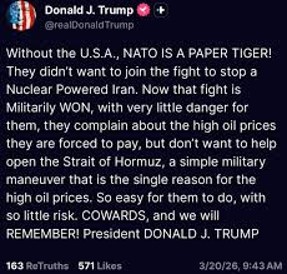
Figure n°1 : screen-shot d’un post du 47e Président sur son réseau social du 20 mars 2026.
Although absurd and tragic, this message encapsulates a certain distaste for NATO: a periphery rejecting the call of the hegemon. The very idea of NATO crystallizes what he detests. It is a historical anomaly, an asymmetrical liberal alliance in which the great power encourages certain behaviors among smaller nations by offering them a channel to influence U.S. foreign policy (Burton, 2012, p. 115; Béraud-Sudreau and Schmitt, 2024, p. 5). He wishes, if not to destroy it, to alter its terms to turn it into a coercive alliance.
To do so, he exploits the disparity in power among allies to ensure the dominance of the strongest over the weakest. It would be wrong to overlook the vengeful and punitive intentions behind his statements and those of his advisors. On more than one occasion, they have implied that the United States could make its military commitment contingent on the adoption of certain political policies in Europe. Everything is being done and will be done to force European countries to accept a structurally unequal relationship, or even to punish them in the event of resistance. Abandoning them outright remains, in the long run, a viable option if they persist in their refusal.
This is why it cannot be ruled out that the United States might seek to disengage from NATO in favor of bilateral agreements—both economic and military—that would allow it to maximize its power asymmetry on a country-by-country basis, thereby shielding itself from any collective retaliation. Some will argue that it is in no way in the President’s interest, nor that of his nation, to do so. After all, Europe remains one of the pillars of American power. They are right, but they may also be making the mistake of projecting a modicum of rationality onto an actor who is, at best, irrational. No doubt we do this to reassure ourselves, to make someone fundamentally chaotic seem predictable: to paraphrase the historian André Loez, he is not the new Machiavelli, but an old man convinced he is a genius—even though the fairies of intelligence, prudence, justice, and temperance clearly bypassed his cradle.
Strictly speaking, the article “American Techno-Thrillers as a Stage for World War: What Role for NATO?” does not address the issue of stupidity fostered by an echo chamber in politics. Rather, the aim was to examine how the Alliance is portrayed during the political and moral ordeal that a Third World War would entail. On this point, the final section is perhaps the most relevant. We drew on Stephen Walt’s work on the future of alliances to contextualize three late-twentieth-century techno-thrillers depicting the demise of NATO: Lary Bond’s Cauldron, and Eric Harry’s ARC Light and Invasion. Considering current events, the first novel, published in 1993, is undoubtedly the most interesting, not for the author’s foresight, but for the accuracy of his observations on the role of leaders. Below is a summary of the work excerpted from the article:
“A financial crisis erupts in Europe in 1993. Riots break out as the crisis takes hold. Much to the chagrin of the United States, the French and German governments implement protectionist measures to end it, but these measures only make the situation worse, as a recession sets in. Tensions between the former allies, against the backdrop of a trade war, lead to the dissolution of NATO. To capitalize on this new political reality, France—now under the control of an authoritarian leader—and Germany form an economic and military alliance that subjugates the CEECs. War breaks out against the United States shortly thereafter: France, abandoned by all, loses the war and undergoes a regime change, from the Fifth to the Sixth Republic” (Cholet, 2026, p.78).

Photo : Nikita Nikitin
If one were to be mischievous, one might say that this is an example of defensive projection—a mechanism whereby one unconsciously projects onto others one’s own flaws that one refuses to admit. But we should heed a recommendation from Lawrence Freedman in his book The Future of War: A History: not to read these stories to assess the authors’ foresight, but because they reflect contemporary attitudes toward war. The story of Cauldron should serve first and foremost as a warning about the U.S. President’s siege mentality regarding the international community. Both in their rhetoric and their actions, the United States is increasingly behaving like an empire—it already was one in territorial terms and now appears to be becoming one institutionally and behaviorally: this predatory exploitation of resources and the weak is not without consequences for the political stability of a country facing two globalized wars, nor for the foundations of its might.
In conclusion, it is worth reflecting on a passage from the l’Iliade ou le poème de la force from Simone Weil: “Such is the nature of force. The power it possesses to transform men into things is twofold and works in both directions; it petrifies, in different yet equally profound ways, the souls of both those who endure it and those who wield it.” Even if it falls far short of the Homeric ideal, the Trump administration’s obsession with unrestrained force and violence is a double-edged sword. It acts like a mirror, and by overusing it —by seeing only through it— the person wielding it ceases to exist they become merely a thing, a corpse. If he is not careful, Trump will learn this the hard way. The United States, too. NATO, likewise. The American renaissance sought by the King of Kings will be less a new golden age than its precipice, its post res perditas.
References
Bereaud-Sudrow, L. Schmitt, O. (2024), Alliance politics and national arms industries: creating incentives for small states?, European Security, 33(4), 711–731.
Bond, L. (1994), Cauldron, Londres, Headline Feature Group.
Burton, J. (2012), NATO after the Cold War: Explaining the Durability of the Atlantic Alliance in a New Global Context, Ph Dissertation, University of Otago.
Cholet, T. (2026), Des techno-thrillers américains comme théâtre de guerre mondiale : quel rôle pour l’OTAN ?, Marché et organisations, 55(1), 55-87. https://doi.org/10.3917/maorg.pr1.0121.
Trump, D., Zanker, B. (2007). Think Big: Make It Happen in Business and Life, New York, Harper.
Weil, S. (1941), L’Illiade ou le poème de la force, Cahiers du Sud.
NB: Article written on 31 March 2026.
The Author
Théo CHOLET holds a bachelor’s degree in philosophy, as well as a master’s degree in political science and another in philosophy. By extension, he is interested in the narrative representation of military affairs as well as U.S. foreign policy.
FOCUS :
Science-fiction et organisations innovantes