17/04/2026
Green Transition: Africa Between New Extractivism and Inclusive Regenerative Innovation


Pitshou MOLEKA
The global energy transition is accelerating at an unprecedented pace, driven by the dual urgency of climate change and profound geopolitical shifts. Governments are redefining industrial strategies, financial institutions are reallocating capital toward low-carbon assets, and multinational corporations are securing access to critical minerals essential for clean technologies. Electric vehicle batteries, solar panels, wind turbines, smart grids, and green hydrogen infrastructures are reshaping global supply chains and reconfiguring the architecture of economic power.
Decarbonization in industrialized economies now depends heavily on a limited set of strategic resources. In this emerging geopolitical landscape, Africa occupies a central position. The continent holds a dominant share of global cobalt reserves, significant deposits of lithium, manganese, graphite, and rare earth elements, and possesses vast renewable energy potential—solar, hydroelectric, wind, and geothermal.
Yet resource abundance does not automatically translate into technological sovereignty or inclusive prosperity. Historically, Africa has often been positioned as a supplier of raw materials, while high-value industrial processing, advanced research, intellectual property ownership, and technological manufacturing have been concentrated elsewhere.
This historical pattern raises a critical strategic question: Will the global green transition reproduce extractive asymmetries under a sustainable label, or can it become a catalyst for inclusive and regenerative innovation capable of transforming African economies and societies structurally?
The Risks of a New Green Extractivism
Africa’s economic history has been shaped by primary commodity exports. From rubber to copper, oil to gold, successive extractive cycles have generated macroeconomic growth without deep structural transformation. Despite industrialization strategies and diversification efforts, many economies remain externally dependent on advanced manufacturing, technological upgrading, and innovation capacity. The global green transition, while environmentally motivated, may paradoxically reinforce this structural dependency in the form of “green extractivism.
– Economic Lock-In and Technological Dependency
If Africa remains confined to mineral extraction without integration into downstream industrial segments, it risks perpetuating technological dependency. The absence of local refining, advanced materials processing, and battery component manufacturing limits skilled employment creation and prevents knowledge accumulation. In the case of cobalt, for instance, the overwhelming share of value is captured during refining, cathode production, and battery assembly—activities predominantly conducted outside the continent. Such fragmentation excludes African economies from high-value segments of global supply chains and constrains technological learning. Without deliberate industrial policy and innovation ecosystem development, Africa risks becoming indispensable to the green transition while remaining peripheral to its technological architecture.
– Externalization of Social and Environmental Costs
Mining expansion carries substantial environmental and social implications: soil degradation, water contamination, biodiversity loss, and displacement of local communities. In several regions, artisanal mining conditions expose workers to precarious labor and safety risks. A green transition that decarbonizes consumption in the Global North while externalizing ecological and social costs to mineral-producing regions does not represent systemic transformation. It simply relocates environmental burdens without addressing structural inequalities embedded in global production systems.
– Fragmented Value Chains and Limited Knowledge Transfer
Innovation is not merely about production output; it depends on learning processes, research capabilities, institutional coordination, and experimentation. When African economies participate only in extractive stages, opportunities for technological upgrading remain limited. The exclusion of local firms from strategic contracts and advanced manufacturing stages inhibits endogenous innovation ecosystems. Without integration into research and design processes, Africa risks being structurally positioned as a supplier rather than a co-creator of clean technologies. The paradox is therefore clear: the global energy transition aims to resolve an environmental crisis but may reproduce long-standing economic asymmetries unless restructured around principles of inclusivity and regeneration.
Inclusive and Regenerative Innovation as a Strategic Alternative
Africa stands at a historical crossroads. It can either accept a resource-dependent role within green supply chains or pursue a transformative pathway grounded in inclusive and regenerative innovation.
Inclusive, because innovation must actively involve local communities, SMEs, researchers, youth, women entrepreneurs, and informal sector actors in design, implementation, and governance processes.
Regenerative, because development must go beyond minimizing harm to actively restoring ecosystems, strengthening social resilience, and building sustainable value systems.
– Local Integration of Value Chains
Strategic mineral processing and component manufacturing represent critical levers for transformation. Developing refining facilities, precursor materials production, and battery-related industries enables value capture and industrial learning. This requiers:
- Massive investment in STEM education and vocational training;
- Reliable energy infrastructure to support industrialization;
- Regional industrial hubs focused on clean technology manufacturing;
- International partnerships based on knowledge-sharing and co-development rather than simple resource extraction.
By embedding African firms within clean technology supply chains, countries can shift from raw material exporters to industrial participants.
– Decentralized Renewable Energy Systems
Africa’s renewable energy potential offers transformative opportunities beyond mineral extraction. Decentralized solar mini-grids, hybrid systems, and off-grid solutions provide context-sensitive innovation models, particularly in rural and peri-urban regions. Such systems stimulate local entrepreneurship, enhance productive use of energy, reduce inequality in access, and support small-scale manufacturing and digital inclusion. In this sense, innovation becomes simultaneously technological, social, and economic.
– Climate Justice and Strategic Sovereignty
Africa contributes marginally to historical greenhouse gas emissions yet bears disproportionate climate impacts. The energy transition must therefore incorporate a dimension of climate justice, involving:
- Equitable access to climate finance;
- Adaptation and compensation mechanisms;
- Active participation in global governance forums shaping green industrial policies.
Climate justice is not only an ethical demand; it is a prerequisite for political stability and sustainable development. Without equitable frameworks, green transitions risk deepening global divides.
The Contribution of Empowering Africa: Harnessing Inclusive Innovation for Sustainable Development
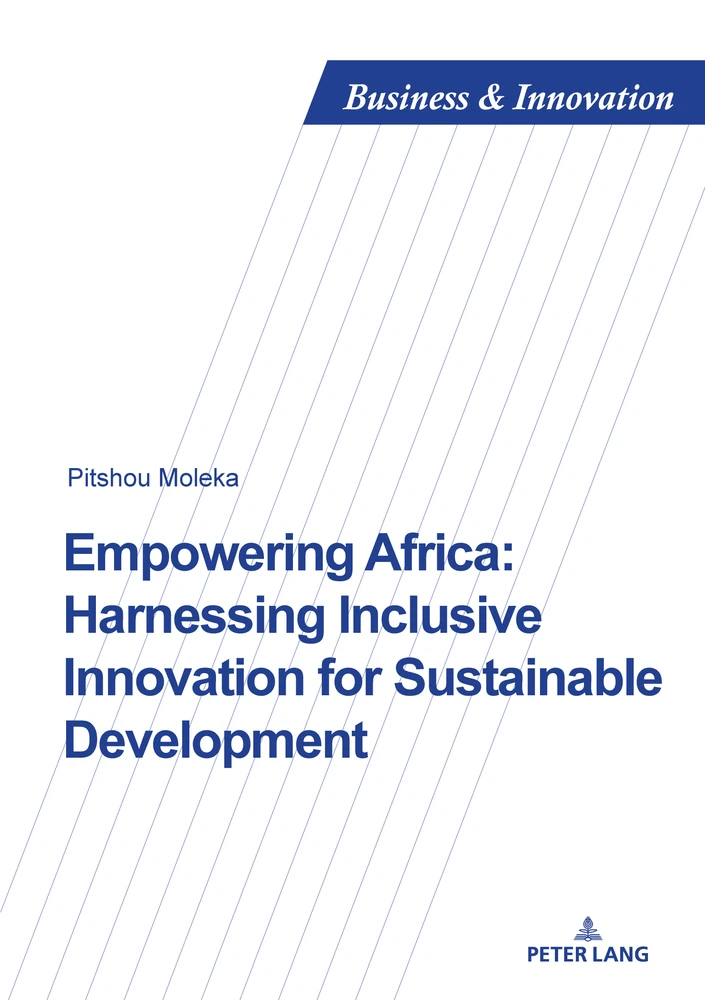
In Empowering Africa: Harnessing Inclusive Innovation for Sustainable Development (Peter Lang, 2026, Monographies XXII, 352 pages, Business and Innovation Series, Volume 38), I propose a conceptual and strategic framework precisely aimed at addressing this historical juncture.
The central thesis of the book is that Africa’s future lies neither in replicating Western industrial trajectories nor in remaining dependent on extractive flows, but in building inclusive innovation ecosystems rooted in African realities.
– Innovation as Systemic Transformation
Innovation must be understood beyond technological invention. It is institutional, organizational, social, and cultural. Sustainable transformation requires regulatory reform, governance strengthening, integration of indigenous knowledge systems, and policy environments that encourage experimentation and adaptive learning. Energy transition strategies must therefore be embedded within broader innovation systems that integrate universities, industry, civil society, and public institutions.
–Inclusion as an Engine of Resilience
The book challenges elite-centered models of innovation. When women, youth, rural entrepreneurs, and informal actors are excluded, innovation systems remain fragile and socially disconnected. Inclusion expands the productive base, enhances resilience, and fosters distributed creativity. In the context of the green transition, this implies designing mineral governance frameworks, renewable energy programs, and industrial strategies that integrate marginalized communities rather than displacing them.
– Sustainability as a Foundational Principle
Environmental sustainability cannot function as a corrective add-on; it must structure economic decision-making from inception. The framework developed in Empowering Africa integrates economic growth, social cohesion, and ecological regeneration into a coherent model of sustainable development. Green industrialization must therefore incorporate environmental restoration, circular economy principles, and long-term ecosystem stewardship.
– From Dependency to Co-Creation
The book advocates a shift toward technological co-creation. Africa must not be merely a site of extraction or industrial assembly; it must become a space of design, research, and engineering innovation. This involves strengthening research institutions, fostering international research partnerships based on reciprocity, and investing in intellectual property generation within African contexts.
In this sense, the theoretical and policy framework developed in Empowering Africa provides analytical tools to navigate the risks of green extractivism while constructing pathways toward regenerative innovation.
Strategic Recommandations
- Establish regional clean-technology industrial hubs integrating mineral transformation and applied research.
- Reform industrial policies to prioritize technological learning and domestic value addition.
- Mobilize African-led green finance instruments dedicated to inclusive innovation ecosystems.
- Strengthen South–South cooperation in renewable energy and battery technologies.
- Institutionalize evaluation mechanisms incorporating social, environmental, and economic performance metrics.
- Invest heavily in STEM education, entrepreneurship development, and research capacity building.
The global energy transition represents a historic bifurcation point for Africa. It may reinforce a sophisticated form of green extractivism, perpetuating dependency and structural asymmetry. Or it may become the foundation of inclusive and regenerative transformation. The decisive factor is strategic agency. Africa possesses the mineral wealth, demographic dynamism, intellectual capital, and renewable energy potential necessary not merely to supply the green transition, but to shape it.
Empowering Africa articulates a framework for transforming resource endowment into systemic innovation capacity. The challenge is not technological feasibility—it is governance, coordination, and political will.
The green transition must therefore be co-constructed, aligning industrial development, social inclusion, and ecological regeneration. Only under such conditions can Africa move from being a mineral cornerstone of the global energy transition to becoming one of its architects.
The Author
Pitshou Moleka is a distinguished professor, a cultural architect, and a pioneer in the sciences of the future; he has also worked as a postdoctoral researcher in innovationology and noesology, the science of new intelligence.
Focus :